Tiger Story: Lost Stripes of Gujarat
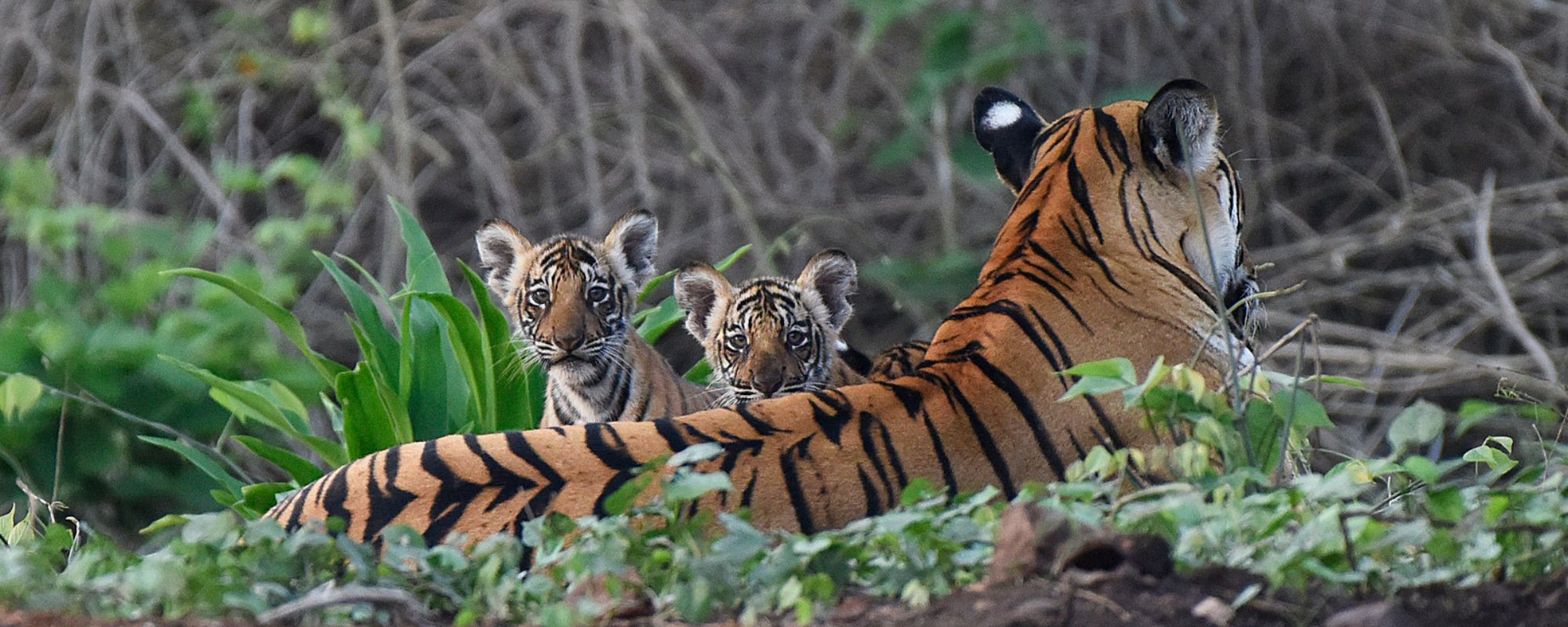
Recently, a tiger that entered Gujarat from Madhya Pradesh and settled down in the Ratanmahal Wildlife Sanctuary has been in the news. It has been widely reported as the return of the tiger to Gujarat after nearly 30 years. However, that reporting is slightly inaccurate because a tiger from Ratapani Tiger Reserve (MP) had also reached Gujarat in 2019 before dying there. Nonetheless, there was a time when Gujarat, the state that immediately conjures images of the Asiatic lion, was home to a sizable tiger population.
At the turn of the 20th century, Gujarat was the only place in the world where you could hope to see four big cats — lion, leopard, tiger, and cheetah. The first two still live in Gujarat. Unfortunately, the Asiatic cheetah (Acinonyx jubatus venaticus) faded away from the state by the late 1930s, when the last one was shot in Junagadh district in 1940. But what about Gujarat’s tigers? What happened to them?
By the turn of the 20th century, even though Gujarat’s tiger numbers were a fraction of what they used to be in the 1850s, they were still common in the forests of Palanpur, Danta, Idar, and other smaller princely states in the north
Gujarat can be geographically divided into three distinct entities: the Kathiawar Peninsula, the salt pans of the Rann of Kutch that lie to its north, and the so-called “mainland Gujarat” with Rajasthan to its north and Maharashtra to its south. Tigers are not recorded from the Kathiawar Peninsula or the Rann; however, they were widespread in mainland Gujarat. In the 19th century, the British-era districts of Ahmedabad and Kaira (Kheda) seem to have been the frontier for both lions and tigers in Gujarat. Both cats were recorded and hunted there, though lions were eventually exterminated in the early decades of the 19th century. Tigers lingered for a little longer. They were shot in areas that now fall within Ahmedabad City, such as the Rani Rupamati Mosque complex, where one was shot in the 1840s. However, by the late 1870s, tigers were gone from Ahmedabad and Kaira, and had receded to the eastern districts of the province, where they were still plentiful. For instance, in the Panchamahals district in eastern Gujarat, 22 tigers were killed in a single year (1865).