An Unseen Battle at the Forest’s Edge
Muscular. Powerful. Strong. These are some of the adjectives that immediately come to mind when one thinks of the gaur. But these are not the adjectives that Dr. Himanshu Joshi, an experienced wildlife veterinarian, attributes to a particular gaur he encountered. “Scrawny, extremely weak, ribs sticking out, his entire body wasting away. That is how I found him. We knew it was too late to save him. Yet we hoped that his suffering would at least be a catalyst towards saving others,” Himanshu recounts.
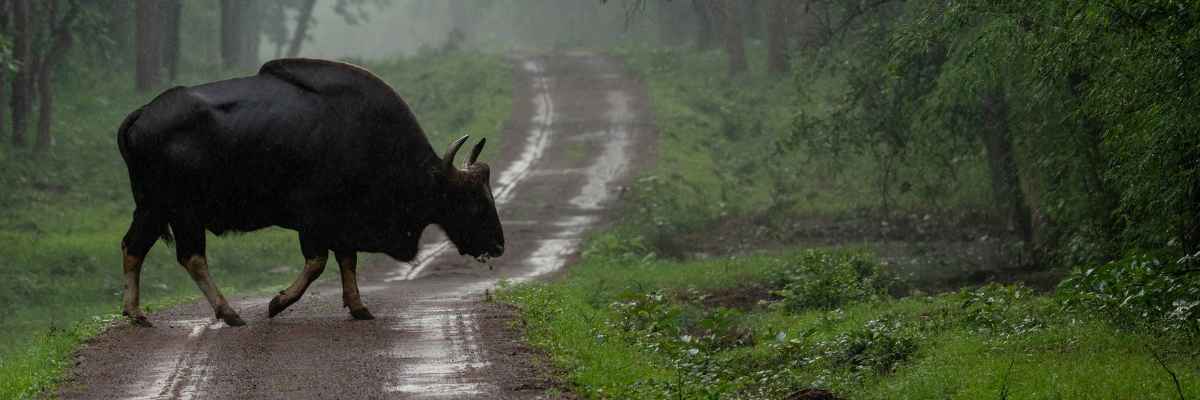
The Indian gaur Bos gaurus – muscular, majestic, and seemingly invincible, yet increasingly vulnerable to invisible threats such as disease at the wildlife–livestock interface.
But what was it that caused such suffering for this gaur? “This gaur was suffering from tuberculosis; a disease transmitted between wild and domestic bovines. Such transmission primarily occurs in forests adjoining villages, which are utilised by both domestic animals and wildlife,” explains Dr. Joshi, Senior Programme Manager with the Wildlife Conservation Trust’s Human Wildlife Interface Management (HWIM) team.
Violent death of wildlife, be it through poaching, road and train collisions, electrocution, or poisoning often makes news. On one hand, such deaths cause anguish among those interested in the well-being of our wildlife; on the other hand, they are the focal points of conservation efforts by governmental and non-governmental organisations. However, the silent suffering of wild animals afflicted by diseases transmitted by domestic animals rarely touches the consciousness of nature enthusiasts, conservationists, and policy-makers. With most deaths occurring ‘out of sight’, this entire issue often is consequently ‘out of mind’ for most conservationists. However, slowly but surely, this hitherto neglected issue is beginning to grab attention. The little-known Sanjay Tiger Reserve (STR) in Madhya Pradesh is an excellent case in point.
A Tiger Reserve Leads the Way
Spread over an area of 1,674.50 sq. km., STR lies in northeastern Madhya Pradesh, along the Madhya Pradesh-Chhattisgarh border. Comprising Sanjay National Park and Dubri Wildlife Sanctuary, along with some buffer areas, the tiger reserve is located primarily in the state’s Sidhi district with some parts extending into Shahdol and Singrauli districts. Across the southern border of STR, in Chhattisgarh, lies the Guru Ghasidas National Park, which was a part of STR before the birth of Chhattisgarh in 2000. The forests of STR were once the famed hunting grounds of the princely state of Rewa, which lost hundreds of the tigers to the gun. They later gained international fame when a ‘white tiger’, subsequently christened Mohan, was captured as a cub in 1951 by Maharaja Martand Singh of Rewa. Mohan is widely regarded as the progenitor of all white tigers in captivity throughout the world. The forests of STR were most recently in the news when the gaur was reintroduced here in 2023-24 after going locally extinct around 1998. However, STR is now scripting yet another milestone, and this time around it is in the annals of conservation policy-making, by bringing disease surveillance to the fore as a critical component of wildlife management.
The Wildlife-Livestock Disease Interface Management programme was introduced in STR in 2020-21 to survey the landscape for endemic and emerging diseases such as Foot-and-Mouth Disease (FMD), bovine tuberculosis, Peste de petits ruminants virus (PPR) and Lumpy Skin Disease (LSD), which can be easily transmitted between livestock and wild herbivores, and pose a threat to wildlife. For the first time, multiple departments and institutions – Forest Department, Animal Husbandry Department, ICAR-National Institute of Foot and Mouth Disease – that had earlier been working in silos and limiting their work to their respective domains began actively collaborating to identify disease prevalence and circulation of pathogens, and improve herd immunity in livestock.
The silent suffering of wild animals afflicted by diseases transmitted by domestic animals rarely touches the consciousness of nature enthusiasts, conservationists, and policy-makers.